2026-09-17
Body v2, in production
A ground-up redesign is on the printer now — first parts already assembled. Built to move on its own up to the point it needs a battery, then another round of changes.
 LACONOVA LABS
Back
LACONOVA LABS
Back
A robot that grows with you.
Mechamon is a walking robot you design, print and wire into ForgeOS — today a hobby project, tomorrow a stepping stone into real robotics as the technology comes of age. Mine's a six-legged walker with two folding arms; yours might be an android or a robot dog. Whatever the body, it plugs into the forge, shares one brain and knowledge base, and keeps getting smarter over time.
A real machine, built the hard way — designed in CAD, printed at home, and wired to a local AI brain. Here's where it stands.
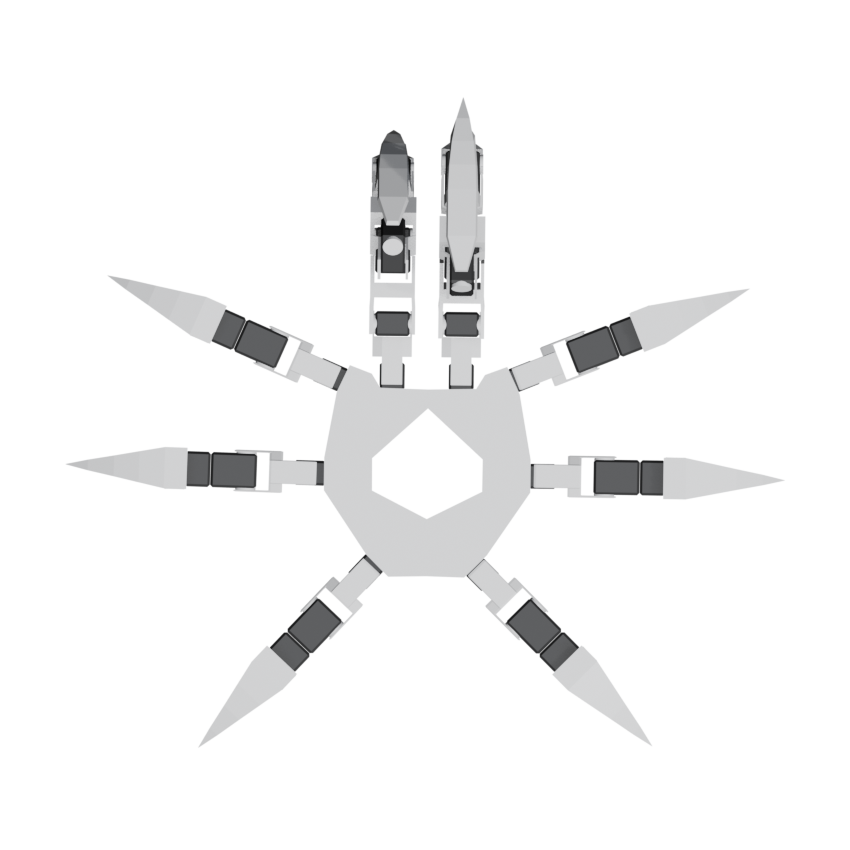
A hexapod walker — print-in-place joints, grown to fit and proven in a render before a gram of filament is spent.
Arms that tuck over the body when they're not needed — a dozen servos in the arms alone.
Drawn in CAD, printed on a hobby printer, assembled part by part. v1 scrapped, v2 on the bed now.
Its brain is the home AI. Servos drive live from the control desk — and, in time, from your phone anywhere.
Six legs plus two six-servo arms is a lot of moving parts for a hobby build — and a lot of weight to move around.
Fitting it all into a compact chassis without stuffing every servo into the arms. That's the puzzle v2 is solving in the open — the first body was scrapped for exactly this.
Mechamon is one instance of a simple idea: an embodied robot you own, wired into your own AI — built to keep growing as robotics comes of age.
Mine walks on six legs. Yours might be an android, a robot dog, a single arm — the shape is up to you.
Whatever the body, it plugs into ForgeOS — the same brain, the same shared knowledge base, the same control desk.
Not a static toy. As the system learns, the robot keeps getting smarter — a companion that grows with you over years, not a kit you finish and shelve.
Built in the open, one honest step at a time — scrapped bodies and all.
A ground-up redesign is on the printer now — first parts already assembled. Built to move on its own up to the point it needs a battery, then another round of changes.
Designed a first body and printed the arm — then scrapped it. Too clunky, too heavy. Better to learn that early and start clean than force a bad design forward.
Mechamon runs on the home AI's brain, and its servos can be driven live from the control desk. The connection that turns a pile of parts into something you can command.
Reliable print-in-place joints — measured, grown to fit, and proven in a render before printing. A repeatable tool for every joint.
Cheap servos, a 3D printer, and a goal: a small walker that moves on its own. First joints turning.